Submarines
Association
Australia
14/08/2026


SubmarinesAssociationAustralia14/08/2026 |
|
|
|
Australians and X Craft
A short account of British midget submarine operations during WW2 in which Australians participated with considerable success. Previously published in ANWM Wartime Issue 19 and the Naval Officers’ Club Newsletter 2003, now reprinted by kind permission of the author.
Belated, Hasty but Effective By contrast with the Japanese program, the British effort was belated and hasty, but finally more effective. Early in 1940, an Army officer proposed the use of midget submarines for laying magnetic mines in shallow water, even producing a preliminary design. An affronted Admiralty took over the project, but progress was leisurely until it became evident that the Germans could station their most powerful ships in the Norwegian fiords, strategically placed to attack Russian or Atlantic convoys. July 1942 Contract
Now accorded a high priority, the midget submarine project went ahead with remarkable speed. In July 1942 an order was placed for six midgets, henceforth to be known as ‘X-Craft‘, while an appeal was made for volunteers (specifically, good swimmers and unmarried) to man them for hazardous service. The men selected were sent to Kames Bay, on the west coast of Scotland, where a depot ship was stationed, and trials began. Sadly, accidents during training cost several lives.
By the summer of 1943 it was possible to plan an operation. The approach of winter would initially provide the cover of darkness, but all too soon the accompanying bad weather would make the ocean tow too hazardous. Once inside the fiords some moonlight would help the four-man crews navigate the X-Craft.
Taking these factors into account, the period 20-25 September 1943 was chosen for the first attack. This was to be on the feared German battleship Tirpitz, which the Allies had made repeated but unsuccessful attempts to bomb, and possibly other ships, in Kaafjord in the north of Norway.
Australian Contributions
Of the six X-Craft participating, three were commanded by Australian Lieutenants:
• X8 by Brian M. McFarlane RAN;
• X10 by Ken R. Hudspeth RANVR; and
• X5 by Henty Henty-Creer RNVR.
Two more Australians, Lieut. Max Shean RANVR and Sub. Lt. William J. Marsden RANVR, were respectively the diver in X9 and the first Lieutenant of X8. In the event, X9 was lost with her outward passage crew when the towing gear failed, and X8 had to be scuttled because of explosive charge troubles. Attack Commences
On the night of 21-22 September the remaining four X-Craft, two commanded by Australians, entered the fiord as planned. Plagued by equipment failure, Lieut. Hudspeth in X10 was unable to reach his target area, but showed great skill in regaining the open sea and the towing submarine. Lieut. Henty-Creer’s X5 was last seen breaking the surface 700 metres on Tirpitz’s starboard bow; it was fired on and disappeared, but his fate is still a mystery. Both of the other attackers, Lieut. B. C. G. Place RN in X7 and Lieut. D. Cameron RNR in X6, reached the Tirpitz and laid charges that put Germany’s greatest battleship out of action until March 1944.
Decorations Well Earned
Place and Cameron survived to receive their Victoria Crosses, but two of X7’s operational crewmen were lost. Hudspeth was awarded a well-earned Distinguished Service Cross (DSC). The removal of the threat presented by Tirpitz to Russian and Atlantic convoys was an immense strategic benefit, and in the heartless way in which these comparisons are made, nine lives was a small price to pay. The next mission was to test the defences of the Home Fleet’s anchorage in Scapa Flow by a simulated attack. Lieut. McFarlane in X22 was chosen to proceed in tow by HMS Syrtis, north from the Clyde. In a storm in Pentland Firth, the two vessels collided and X22 was lost with all hands. Lieut. Shean in X24 was chosen to continue the trial, which was successfully completed. He was also chosen for the next target, once again in Norway: a large floating dock in Puddefjord, near Bergen, known to be in constant use for U-boats and perhaps able to take the Tirpitz for repairs. Towed by the submarine Sceptre (commanded by another Australian, Lieut. I. Macintosh RN), Shean’s craft slipped the tow in darkness off the Bergen Leads on 13 April 1944.
Exemplary Style
The attack the following day was carried out in the exemplary style that was to distinguish Shean in war and later in peace. The long entrance channel was successfully negotiated, the charges were released under the target with unhurried accuracy, and after another long transit of the channel contact was made with the towing submarine in the open sea. A textbook operation was completed when X24 returned to base, but the jubilation was dampened when air reconnaissance showed that a German cargo ship (the Barenfels) had been sunk, instead of the floating dock.
Wrong Target
It was later found that since the printing of the chart issued to Shean an additional berth had been built nearby, with similar orientation. With accurate briefing, the story might have been different. Shean begged to be allowed to return to Bergen, but this was not possible. For his mistaken success, Shean was awarded the Distinguished Service Order (DSO), rarely given to an officer of his seniority.
Normandy Beaches
With the invasion of Europe imminent, it had become necessary to get detailed data on the chosen landing beaches. In January 1944 Lieut. Hudspeth was sent in X20, with specialist personnel, to survey and collect samples from beaches of particular interest. The mission was successful, earning Hudspeth his second DSC. For the invasion proper, Hudspeth was detailed to moor X20 as a navigational beacon off Juno beach, joined by another X-Craft off Sword Beach. His role in the landings won Hudspeth yet another DSC.
With the war at sea now focussed on the Pacific theatre, an improved type of X-Craft was built. Designated the XE series, they were slightly longer, with refined equipment and modifications aimed at improved habitability in the tropics. Transported from Britain in the mother ship HMS Bonaventure, the first task – the cutting of the submarine cables between Singapore and Saigon, off Cap St Jacques in Vung Tau province, near the mouth of the Mekong River – was given once again to Lieut. Shean.
Shean Cuts Cable
After appropriate training in a new technique, Shean in XE4 did the job perfectly on 31 July 1945. One of his two divers was another Australian, Sub. Lt. Kenneth M. Briggs RANVR. For this operation Shean received a second DSO, and also the US Bronze Star, while Briggs was awarded the DSC. In a similar operation at the same time, Lieut. H. P. Westmacott RN in XE5 attempted to disable the submarine cable off Hong Kong. Though he was uncertain whether he had succeeded or not at the time, it was found out after the war that he had indeed put the cable out of action.
Cruiser Takao
The most spectacular operation was carried out by Lieut. I. E. Fraser RNR in XE3. His main target was the Japanese cruiser Takao, anchored in the Johore Strait. In shallow water, the main explosive charge was laid under the cruiser, while magnetic limpet mines were attached to the hull. Both Fraser and his diver, LSEA J.J. Magennis, were awarded the Victoria Cross.
By the war’s end, Australians in X-Craft had won two DSOs, four DSCs and a US Bronze Star. Sadly, three of them lost their lives. Compared with the Japanese record, the British midgets had achieved very important successes and shown that it was possible to use these craft to strike enemy targets and return safely to base.

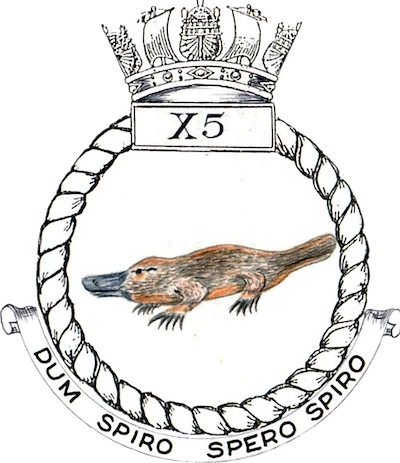
At daybreak on 22 September 1943 off the Norwegian coast, the operational crew of HMS X5 (Lt H Henty-Creer) embarked in the midget submarine X5 from HMS THRASHER that had towed X5 across the North Sea in preparation for the attack on the German Battleship Tirpitz in Kaa Fjord (Operation SOURCE). X5 was released from THRASHER together with X6 and X7 from their towing submarines (HMS TRUCULENT and HMS STUBBORN respectively) and proceeded to penetrate the fjord. X5 was sighted by X7 after the 3 X-craft had crossed the mined area just before the attack. This was the last definite sighting of X5. It is not certain what happened to X5, but it is believed that she may have been sunk by Tirpitz 4-inch guns whilst approaching the target. The part played by X5 in the attack is therefore unknown but, sometime after the attack, divers found wreckage possibly (but not definitely) of X5 about 1 mile to seaward of Tirpitz, halfway between her and the entrance to Kaa Fjord. No bodies or personal gear were found, and of survivors there was no trace. PEOPLE WHO DIED WHILE SERVING IN THIS UNIT
Lt H HENTY-CREER RNVR, MALCOLM A D, Sub Lt RNVR, MORTIBOYS R J ERA 4, NELSON T J, Sub Lt RNVR
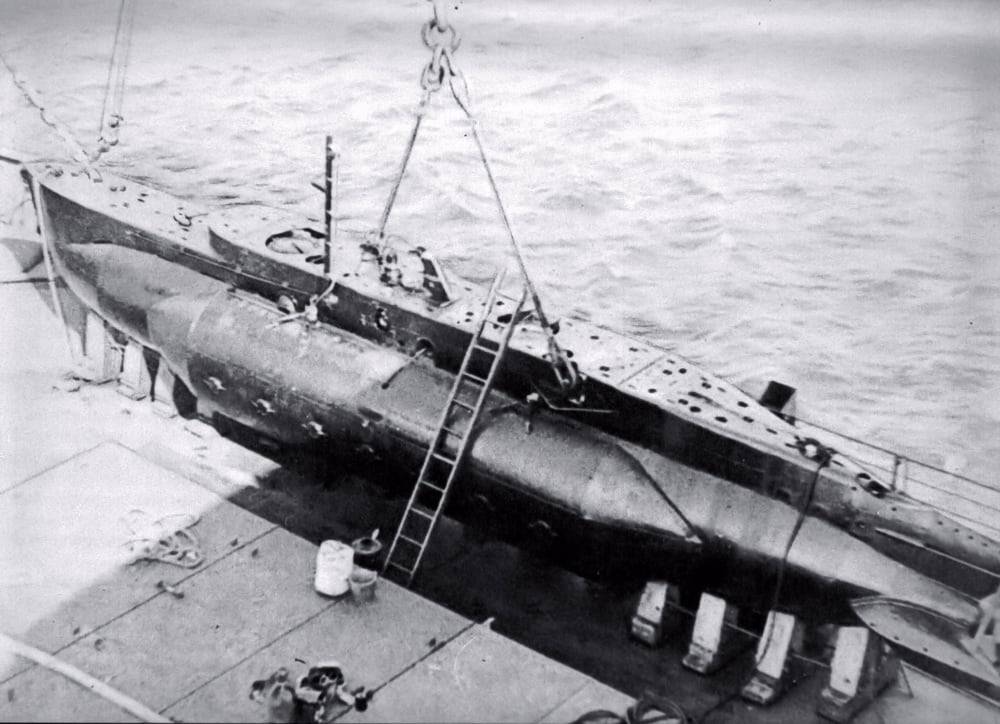
The secret mini-submarines that played a crucial role in World War II
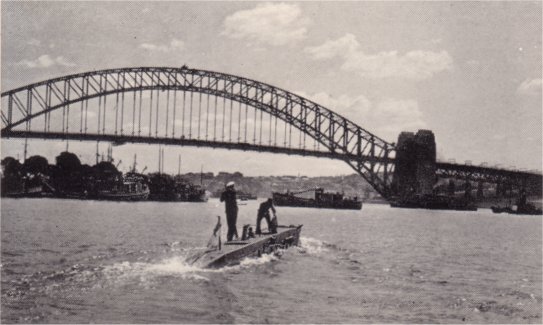
Martime pictures to emerge in recent years. A midget submarine with two navy crew taking in the view of Sydney Harbour. This is three years after the Japanese midget submarines penetrated harbour defences in 1942 during World War II.
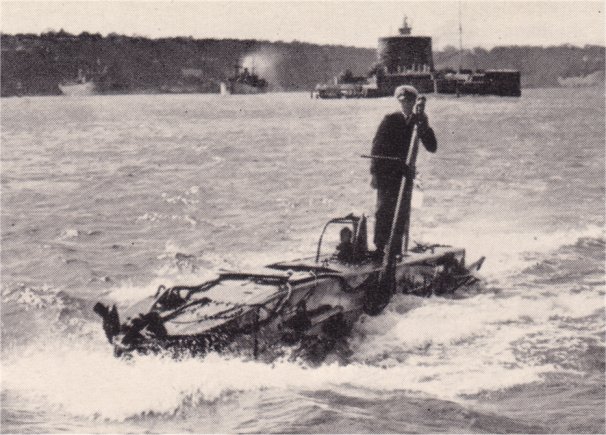
Allied midget XE3 submarine in Sydney Harbour, 1945.
The image is of an Allied midget submarine X-craft used to cut underwater telephone cables used by the Japanese. The submarine was 16 metres long, had a displacement of 30 tonnes, a diesel engine and electric motor and was capable of 6.5 kts (12km/h) at the surface. It had a crew of four, who included a diver, and carried two explosive charges that could be detonated remotely.
One navy source said: “The photo of an X-craft on the surface of Sydney Harbour with the bridge in view, given operational security surrounding X-craft, may be unique.”
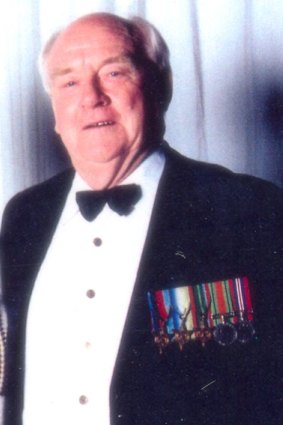
John Beams wearing his service medals.
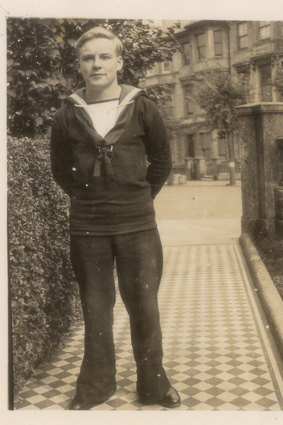
The picture is part of a memoir that has emerged with the death on December 31 of submariner Sub Lieutenant John Beams, who operated with the flotilla of midget boats in the Pacific before they returned to Sydney after the Japanese surrender in September 1945.
From Worcestershire in the Midlands, he joined the Air Raid Precautions Civic Defence at the age of 13. He enlisted in the Royal Navy in 1943 aged 17. After initial training he transferred to the Isle of Bute in Scotland to train on X-craft (which were succeeded by the XE class), the idea being that they would be used to sink German warships.
Australian Lieutenant Henty Henty-Creer died commanding a similar midget submarine, X5, after the attack on the German battleship Tirpitz in Altafjord, Norway, in 1943.
HMS Bonaventure (the depot or mother ship) and six XE-craft submarines sailed for Australia on February 21, 1945, via the Panama Canal. Beams was 2nd Commanding Officer of XE-craft 3.
In his memoirs, Mr Beams wrote: “What took a little bit of getting used to was the security and secrecy that surrounded the whole training program.” In Hervey Bay, off Bundaberg, divers experimented with cutting cables. “All in all, a very steep learning curve with little time,” he wrote. “Unfortunately in two days it cost two lives, Lieutenant David Carey and Lieutenant Bruce Enzer. They appeared to go berserk. It was put down to the fact that they were both extremely fit but overexerted themselves, and they were probably suffering lack of oxygen to the brain.”
Dr Michael White, former Australian submariner and author of Australian Submarines: A History, was aware of the “remarkable” picture and said it represented people of enormous courage and ability.
He said the British submarine and the Bonaventure sailed up to Subic Bay in the Philippines. “One of the submarines with an Australian captain and diver then went on and cut the cable at great risk, off Vietnam. Another one later cut the cable at great risk at Hong Kong and that had a major impact on the war. The Allied midget submariners were the best of the best.”
Mr Beams added: “With the return of the X-craft, operations were deemed to have been reasonably successful. We were all getting prepared for the next lot of operations. [On August 6] the first atomic bomb was dropped on Hiroshima. On the evening of August 15 Bonaventure received the signal: “Cease hostilities against Japan.”
The Bonaventure was ordered to return to Australia. “We arrived in Sydney, anchored in the harbour. XE4 was put into the water with the end of the war, and they went to Sydney post-war. [We] as crew did some trial runs on the defence of Sydney Harbour at the heads. Then very hush-hush.
NEARLY 66 years ago, a flotilla of mini-submarines set off to sink or cripple the mighty
German battleship Tirpitz. Among the men behind this attack was Max Shean from Perth, a
volunteer for one of World War II's most daring and hazardous naval missions.
Shean's courage in command of the X-craft submarines in Europe and the Pacific earned him an unrivalled
reputation as a leader whose aggressive instincts were always tempered by concern for his crew.
He died on June 15, aged 90.
Born in July 1918, Shean was in his third year of an engineering degree when news of the Dunkirk evacuation
inspired him to join the Royal Australian Naval Volunteer Reserves. A man of slender build, Shean was no
swashbuckler. He was a man of quiet purpose, optimism and integrity. He was a meticulous planner. Shean
trained in anti-submarine warfare in Sydney before serving on a British corvette, HMS Bluebell, on Atlantic
convoy escort duty.
When the British admiralty called for volunteers for "special and hazardous service", he volunteered without
hesitation. After 15 months crossing the U-boat infested North Atlantic, Shean thought this special service
couldn't be more hazardous than what he had been doing.
Unaware that his new job meant manning top-secret X-craft submarines, he joined 12 other volunteers and
began training at the submarine base HMS Dolphin, Gosport, in 1942. They soon learned that their mission was
to penetrate German harbour defences with a crew of three.
Each had to be competent divers, so they could cut their way through anti-submarine nets to lay a pair of twotonne
explosive charges under the Tirpitz, an awesome machine of war that threatened Britain's trans-Atlantic
supply lines. They had six months to prepare for the attack, which was initially planned for April 1943.
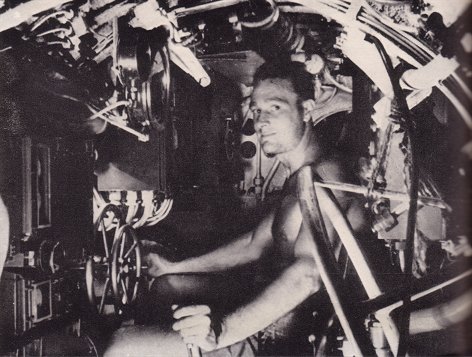
Conditions were cramped on the X-craft. These submarines were developed to penetrate the most heavily
defended waterways and survive unrealistic odds.
Shean's engineering skills proved crucial during the X-craft sea trials. The X-craft became part of him for the rest
of his life.
He was the perfect choice for such a mission. With his energy and friendly nature he became a popular member
of the young group of submariners. In an effort to maintain secrecy, the British navy applied strict rules, but
Shean wanted to capture the moment and smuggled a small Box Brownie camera in with him. As a result, he
developed a unique record of the X-craft world.
However, the biggest obstacle to their mission was developing a means to cut the anti-submarine nets protecting
the Tirpitz at its anchorage in a Norwegian fjord. In early training attempts to cut a submarine through a net, all
divers had had great difficulty and one unfortunately drowned in the process. It fell on Shean to devise a
solution.
Typical of a man who grew up playing around with boats on the Swan River, Shean found a way. He felt this to
be his greatest contribution to the war effort.
In September 1943, Shean set sail with six X-craft submarines to carry out Operation Source, the sinking of the
Tirpitz in Kaa Fjord. Although qualified as an X-craft commanding officer, Shean was appointed as the diving
officer of X-9.
To reach the operations area, the X-craft had to be towed by an ocean-going submarine. Shean was on board the
towing submarine, HMS Syrtis, with the rest of X-9's operational crew when it was discovered that X-9 had
broken the tow and disappeared.
The shredded towline had become caught in Syrtis's port propeller and Shean was sent out to clear the snag.
Working without his diving suit, which was in X-9, he dived into the freezing Arctic waters and managed to clear
the line. However, the X-9, which was being manned at the time by another crew, was lost with all hands. The
operation was over and, with it, Shean's chance to take part. The X-craft eventually achieved their mission and
the Tirpitz was so severely damaged that it never put to sea again. But none of the X-craft survived the raid and
nine men were lost.
Soon after returning from Operation Source, the British had built more X-craft, and in April 1944 Shean was
appointed in command of the X-24 for Operation Guidance. The Germans had been using Bergen in Norway as a
U-boat base, with a floating dock for maintenance and repair. It was Shean's task to destroy the dock, an almost
impossible task given that the approach was 40 nautical miles from the open sea through busy and confined
waterways patrolled by German vessels and protected by two minefields and anti-torpedo nets. The X-24 was
towed to the drop-off point by HMS Sceptre, commanded by another Australian submariner, Ian McIntosh. At
dusk on April 13, McIntosh slipped Shean's submarine and X-24 dived. Before departing, the two Australians coordinated
a rendezvous. This mission was perilous from its inception and never before had only one X-craft been
considered for such an operation.
Reflecting on Shean's selection as the submarine's captain, his engineer Vernon "Ginger" Coles said: "Max was
the only captain I would sail with. When we went into Bergen the demeanour of Max was such that one would
have thought we were going on exercise. He was cheerful, confident and pleased that we were doing something
useful with no thought of not coming back."
Shean was just 25.
The X-24 negotiated the minefields and, on returning to periscope depth, passed so close to a patrolling German
patrol boat that Shean could see its swastika flag. Shean calmly ducked directly underneath. The X-24 slowly
crept up to the target area, where Shean manoeuvred the X-24 close to the Bergen docks. As he approached his
target, Shean could see the wharf facilities looming out of the haze. The basin, however, was full of busy marine
traffic. Later, he confided that it was at this point he was overcome with fear, but his sense of responsibility for
his crew forced him to keep a steady head. He had to do the job. He had to get his crew home safely. He took the
X-24 deep and made his run to the target.
The underwater picture was confused but the X-24 laid the charges, set with a four-hour time delay. Exhausted
and starved of fresh air, Shean and his crew steered back through the heavily defended waters to the rendezvous
with Sceptre. In the dark night that awaited them, a relieved McIntosh greeted Shean with a submariner's
nonchalance, but through their exploits the young Australians forged a deep bond and remained close friends for
the rest of their lives.
On their return to Scotland, Shean was to learn that faulty intelligence and incorrect charts had led him to lay the
charges on a large enemy ammunition ship, the Barenfels, which was destroyed. Shean asked to be sent back for
a second attack, a request that was refused. The British claimed the attack as a success; a significant target was
sunk and the X-craft returned unscathed.
After the previous Tirpitz raid, when all six boats were lost, morale in the flotilla was low. The mere fact Shean
had penetrated a heavily defended fjord and harbour 40 nautical miles deep and returned home was a great
morale booster. It was the first time an enemy ship had been sunk at its berth without any loss to Allied navy
personnel. More significantly, the attack proved to be a strategic success and the Admiralty gained great
confidence in the ability of the X-craft in the war effort. This would later prove vital in the Pacific.
Shean was awarded the Distinguished Service Order for his leadership.
But a new threat had arisen and, following D-Day, the X-craft were required in the Pacific. Leaving his new bride
in Scotland, Shean was posted to a submarine depot ship and sailed to the Pacific. He was again selected to
command a special mission in which he was given the job of cutting two submarine telegraph cables that were
part of the Japanese communications network linking Singapore, Saigon, Hong Kong and Tokyo. The Allies
could not intercept and listen to Japanese communications sent via these underwater cables. If the X-craft men
could sever this link, then the Japanese would have to revert to their secondary radio communications, which the
Allies had the means to decipher.
At that stage it was vital for the war effort to understand the Japanese intentions, for it would be the cue to the
Allies on whether to drop the atomic bomb. The mission was no easy task and Shean's engineering background
again proved most useful. He developed a special flat grapnel for XE4 that was eventually used for the X-craft
mission.
After training in Hervey Bay in Queensland, Shean sailed to Borneo in July 1945, then to The Philippines where
the X-craft were launched on their mission to Saigon. He almost drowned en route after being swept overboard
but was able to swim back and climb aboard after swimming the fastest few strokes of his life.
On July 31, the cable was cut. For his efforts in the Pacific, Shean was awarded a bar to his DSO and a US Bronze
Star.
On completion of the war, Shean graduated with honours in engineering before a career in the West Australian
power industry. He was an avid sailor and in 1978 sailed his yacht Bluebell from Fremantle to Britain in the 150-
year celebration Parmelia race, in the open division, which he won.
Shean was a proud submariner until his final days. He maintained close links with his X-craft comrades; Coles
and he wrote to each other every three months.
McIntosh and Shean together were patrons of the submarine museum in Fremantle.
Shean is survived by his wife of 65 years, Mary; two daughters, Ruth and Heather; five grandchildren; and three
great-grandchildren.
Timothy Brown is a serving submarine officer in the Royal Australian Navy.
Just a normal sailor on AE1
1068 Petty Officer (SG) Robert Smail,
HMAS AE1 Accidentally killed: 14 September 1914
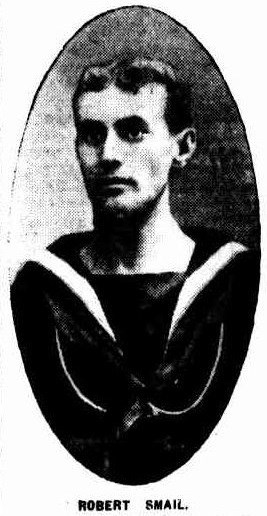
Today we remember and pay tribute to Petty Officer Robert Smail.
Robert Smail was born on 26 January 1888 in Galashiels, Scotland, the son of Robert and Elizabeth Smail.
He attended school in the village of Spott, south of the coastal town of Dunbar. After leaving school at the age of 16, Smail joined the Merchant Service. He served on the Baltic trade route before joining a four-masted sailing ship Loch Tay with a cargo bound for Port Melbourne.
During the journey Loch Tay was becalmed and the cargo had to be offloaded to another ship. As a result, the crew were discharged in Australia. Smail then joined a ship, possibly the SS Cooma, as it plied its trade along Australia’s eastern sea board.
Smail joined the Commonwealth Naval Service on 3 August 1908, signing on for five years. With his previous service as a merchant sailor taken into account, he was awarded the first of his good conduct badges in January 1909.
He was sent to Scotland along with other sailors to commission the Commonwealth Naval Forces ship Yarra, a 700-ton torpedo boat destroyer. The ship was commissioned in early September 1910 and sailed for Australia shortly after in company with her sister ship HMAS Parramatta. The ships arrived in Australia in November. During the ship’s voyages around Australia Yarra stopped in at Launceston, where Smail had friends.
In mid-June 1911 Smail was promoted to petty officer. A year later he was sent to the shore establishment HMAS Cerberus. On 1 July he signed on for a further seven years’ service with the navy and sailed for England with men who had been selected to crew the now Royal Australian Navy’s new E Class submarines.
Arriving in England, he travelled to the Vickers Shipyard in Barrow, Furness, Scotland, and witnessed the building and launch of HMAS AE1.
While in England, Smail took every opportunity to visit his family, and convinced them to move to Australia, paying for their travel and a deposit on a house in Melbourne.
Smail’s second good conduct badge, which would have been for his leadership and drive during the sea trials of AE1, was awarded in January 1914. In March, AE1 and AE2 sailed from Portsmouth, bound for Sydney.
The journey was arduous, with both vessels suffering mechanical problems. At times the operating temperature inside the submarine would reach 38 degrees Celsius, and the air became toxic, polluted by gases from the engine room.
In May 1914 the submarines reached Sydney and were met with intense curiosity from the public. To the imaginations of the Australian people, the underwater capsule of Jules Verne’s novel 20, 000 Leagues Under the Sea “was the stuff of science fiction”.
When the First World War began in August 1914, the submarines were assigned to the RAN component of the Australian Naval and Military Expeditionary Force, providing forward protection to the fleet as it made its way to New Britain.
The ANMEF went into action on 11 September and captured the radio station at Bitapaka late in the afternoon. Three days later, AE1 and HMAS Parramatta departed Blanche Bay to patrol Cape Gazelle.
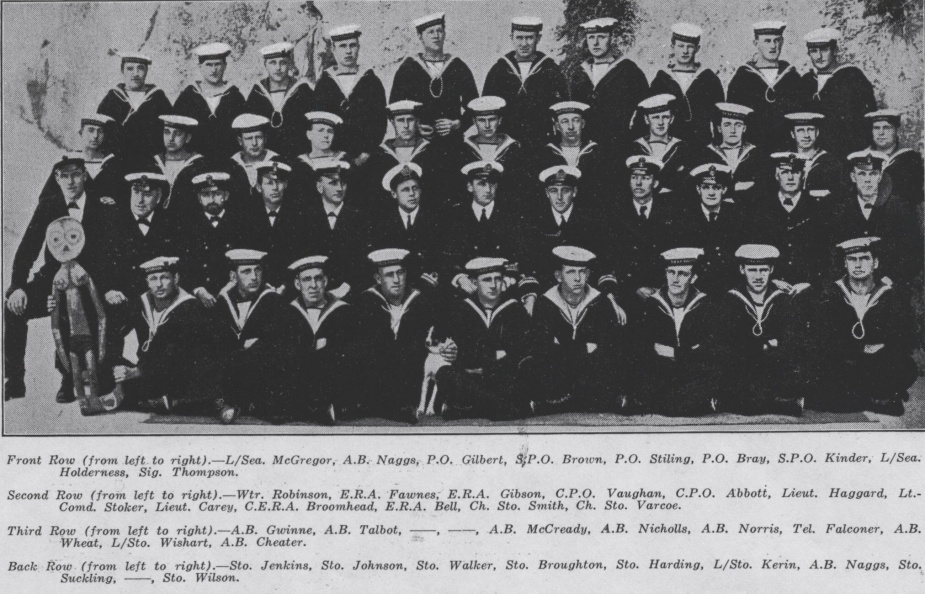
AE1 was last seen by HMAS Parramatta at around 2.30 pm. When the submarine had not reported in by 8 pm, ships were sent to look for the missing vessel, but despite searches of the area, “no trace of the AE1 was ever found, not even the tell-tale shimmer of escaping oil in the water.” The crew of three officers and 32 sailors were believed to have drowned. Robert Smail was 26 years old.
It was a sore blow to the fledgling Royal Australian Navy. The loss of HMAS AE1 with all hands was the first loss of an RAN vessel.
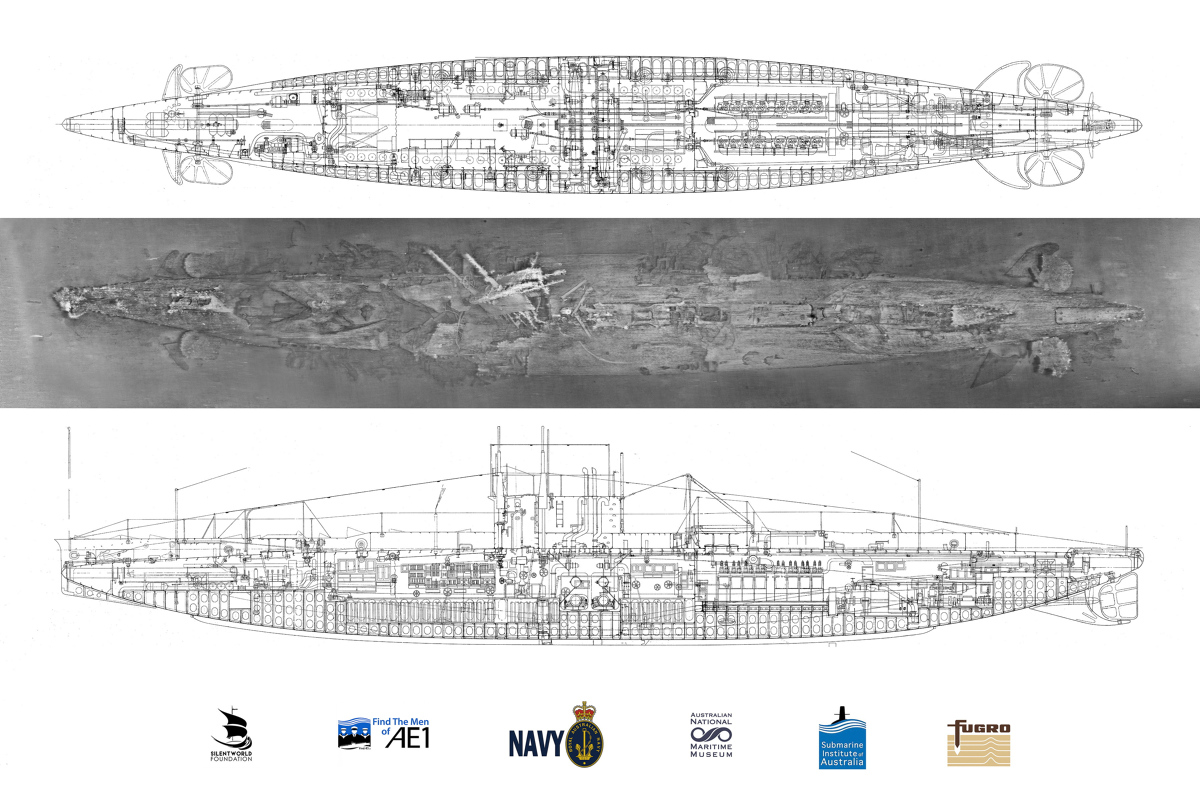
Despite searches, the wreck of HMAS AE1 was unable to be located. In December 2017 a multi-national team aboard the survey vessel Fugro Equator located the wreck of AE1 off the Duke of York Islands. The ensuing investigation found that the sub’s loss was caused by a ventilation valve in the hull which had been partially open. It was not clear if it had been human error or a mechanical fault, but as the sub began its dive, water flooded the engine room. When AE1 reached its 100 metre crush depth, an implosion is believed to have torn through the vessel, killing all on board instantly.
Today Robert Smail and his crewmates are commemorated on the Plymouth Naval Memorial in the United Kingdom.
He joined the Royal Navy on 15 September 1898 at HMS BRITANNIA where he was under training until 14 January 1900. and was appointed to the cruiser HMS ENDYMION and then to the cruiser HMS AMPHITRITE in 1902 where he served until 1903. After his Lieutenant's Courses he served in destroyers HMS HEARTY, HMS FAIRY and HMS VIXEN before being appointed to the battleship HMS RUSSELL in 1904.
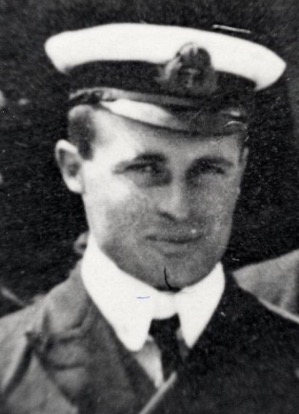
Thomas Besant was first appointed to the Submarine Depot Ship HMS THAMES at Portsmouth ‘for Training in Submarines’ in 1905. He was promoted to Lieutenant and re-appointed ‘for Command of Submarines’ in 1906. In 1907 he took command of HMS C12. In 1910 he returned to the Surface Fleet for his ‘Big Ship’ time with an appointment to the battleship HMS KING EDWARD VII and, in 1911, to the battleship HMS HERCULES.
His next submarine appointment came in 1912, in command of HMS C30. In 1913 he was ‘loaned to the Royal Australian Navy for Submarine Service’ to take up his new appointment to the Submarine Depot Ship HMAS PENGUIN ‘for Submarine AE1 in Command’.
Thomas Besant was promoted to Lieutenant Commander in December 1913 and, after a ‘Commissioning Ceremony’ at Portsmouth, HMAS AE1 made the passage to Australia, arriving in Sydney in May 1914. After refitting at Sydney HMAS AE1 joined the Australian Forces at the Bismarck Archipelago but disappeared with the loss of all hands off the Island of New Britain in the Pacific on 14 September 1914.
25 April 1915
HMA Submarine AE2 was Australia’s second submarine. Launched in June 1913, it had a crew of both Royal Navy and Royal Australian Navy officers and sailors under Lieutenant Commander Henry Hugh Gordon Dacre Stoker RN.
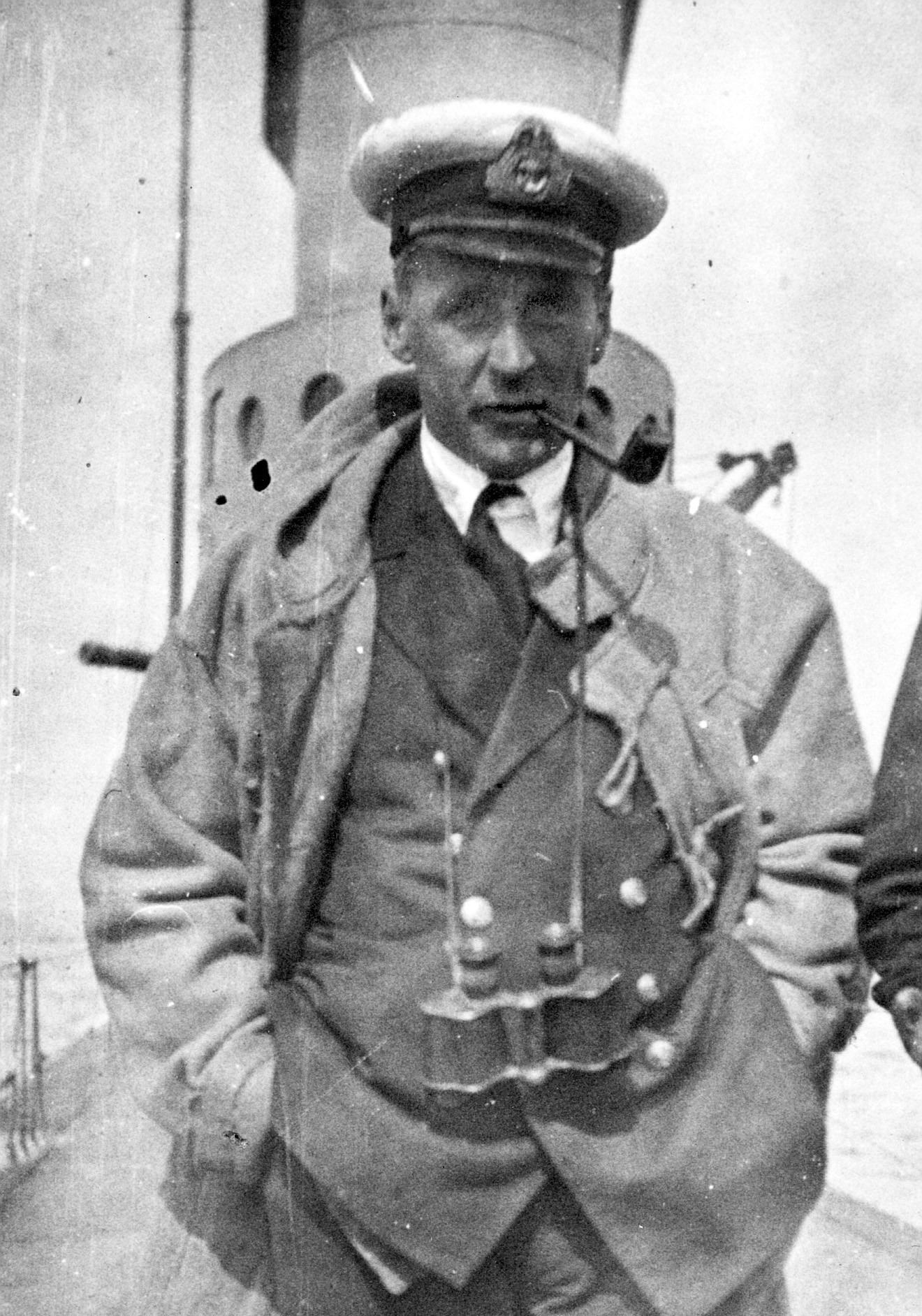


Following service elsewhere at the start of the war, AE2 met with the second convoy of the Australian Imperial Force (AIF) in Albany. It then sailed for Suez, via Colombo, on 31 December 1914. The following February, AE2 joined a Royal Navy squadron based on the island of Tenedos in the Aegean Sea. From there, it supported the unfolding Dardanelles campaign.
Prior to 25 April, AE2’s role had been minor. That was until Vice-Admiral John de Robeck, Commander-in-Chief of the Eastern Mediterranean Fleet, approved plans by AE2’s commander, Stoker, to force entry through the Dardanelles Strait into the Sea of Marmora. If AE2 could achieve this, it would stop enemy shipping from transiting between the Bosphorus and the Dardanelles. It would then stop the reinforcement and resupply of Turkish troops on the Gallipoli Peninsula.
All previous attempts by Allied submarines to pass through the strait had failed. This was due to an effective sea denial operation mounted by the enemy. Several factors contributed to making the Dardanelles seemingly impenetrable:
minefields
fixed and mobile gun batteries
searchlight surveillance
patrolling Turkish warships
natural navigational hazards.
AE2’s first effort, on 24 April, was abandoned when the submarine’s forward hydroplanes failed and had to be repaired.
On 25 April 1915, just hours before ANZAC troops landed on the Gallipoli Peninsula, Stoker braved the gun batteries and mines and attempted to penetrate the Dardanelles. Though pursued by surface ships and at times under fire from the shore, AE2 passed through the ‘Narrows’ late in evening. Stoker surfaced to communicate this success to his superiors aboard HMS Queen Elizabeth.
The commanders, who had been at that moment discussing a general evacuation of the Gallipoli Peninsula, were convinced to keep Allied forces on the peninsula. They used the news to boost morale and convince troops ashore at ANZAC Cove to dig in.
AE2 entered the Sea of Marmora on 26 April and, over the following few days, patrolled for ships and transports to sink, but was unsuccessful on several occasions. Nevertheless, Stoker proved the value of submarines. AE2’s presence tied up numerous Turkish assets.
On 30 April, AE2 was hit by a Turkish torpedo boat and sunk, and the crew was captured. Four sailors died in captivity; the rest of the crew were released in 1918.
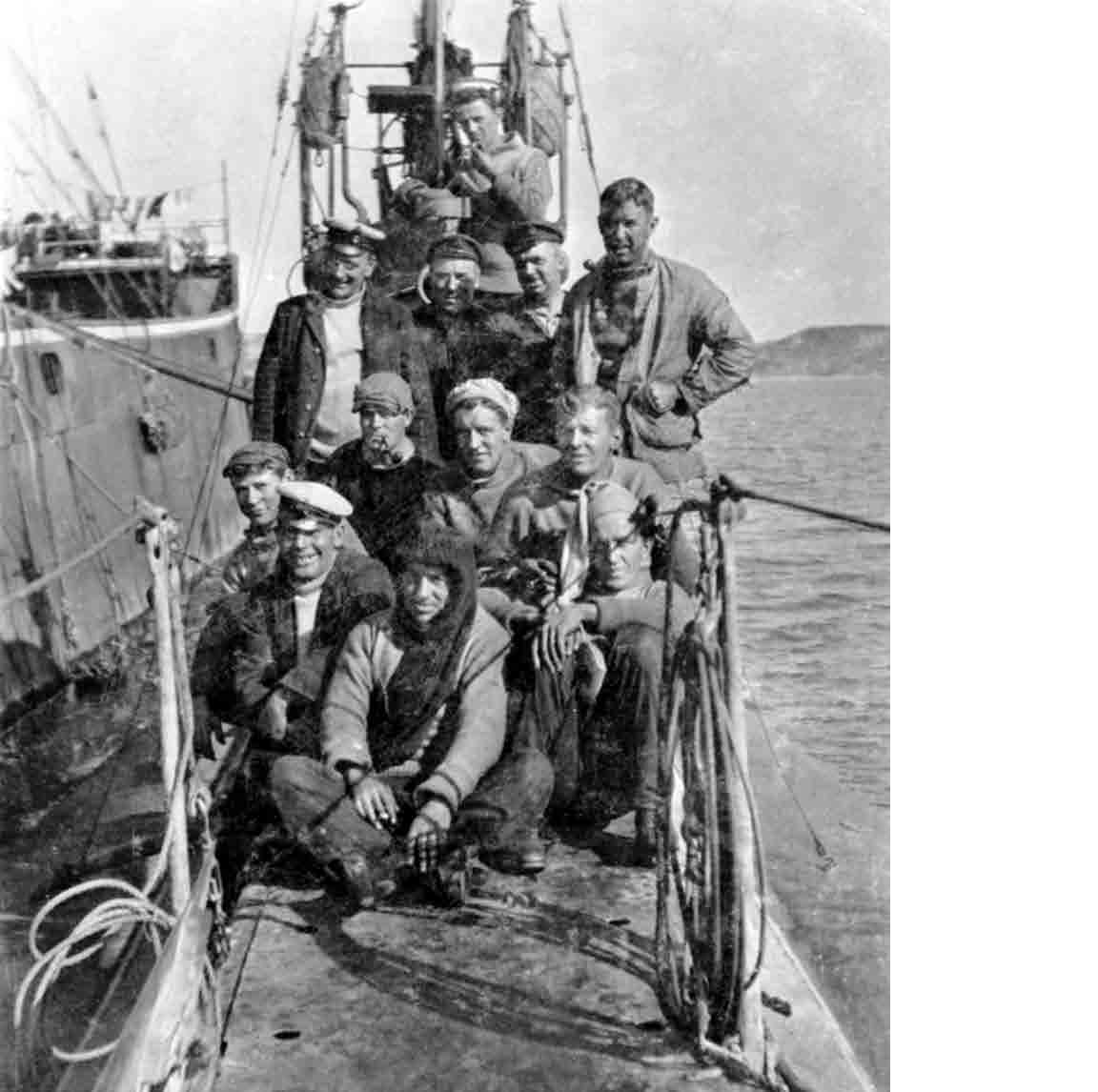
Images of AE1 and 2 in Australia and O/S
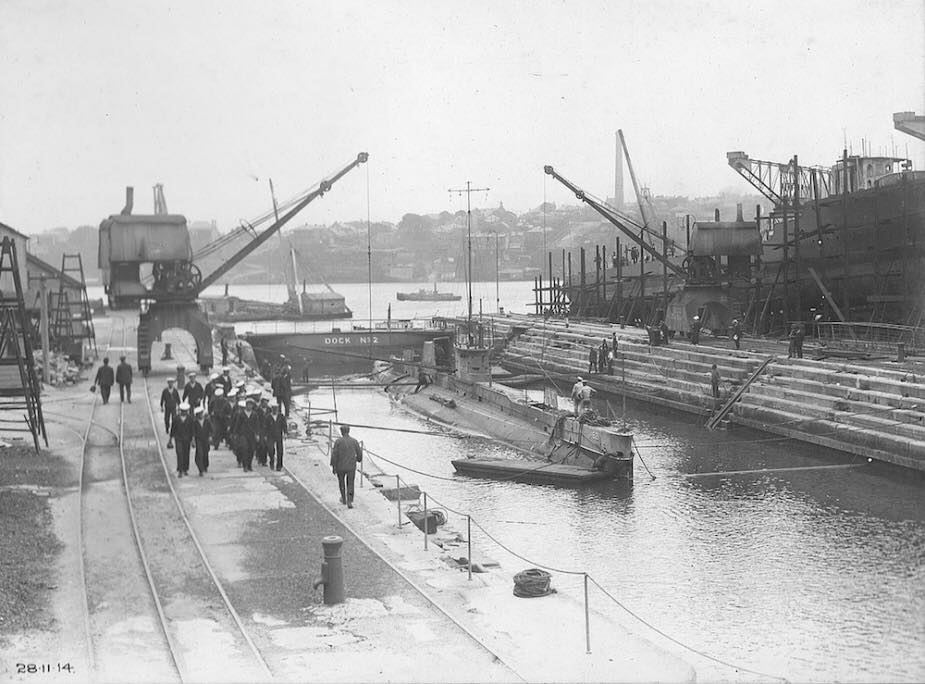
.jpg)

So far she has been the only ship of the Royal Navy (RN) to bear the name Trump. She spent the majority of her life attached to the 4th Submarine Squadron based in Australia. She was kept in service following the war and was refitted for greater underwater performance, and was the final RN submarine to be posted in Australia, departing in January 1969. She was sold off and broken up for scrap in August 1971.
Design and description
HMS Trump was one of the group three of T-class submarines. She was part of the second batch of the third group to be ordered, in 1941. She was one of a number of boats which had an all-welded hull which increased diving depth to 350 feet (107 m), an increase of 50 feet (15 m). The torpedo armament was the same as the earlier group two, although by the time group three was coming into service it was realised that external torpedo tubes had major problems and affected the streamlining of the boats; the external tubes were abandoned in the following Amphion class. Due to expected use in tropical climates, boats of group three were equipped with freon blowers in order to deal with the increased temperatures.
Service World War II
Trump was commissioned in July 1944. After trials and a work-up in the North Sea in mid-October she was sent to Perth in Western Australia. On arrival, she joined the 4th Submarine Squadron, supported by the depot ship HMS Adamant. From Perth, Trump carried out four patrols before the end of the war.
During her Far East service, Trump sank the Japanese guard boat No. 15 Shosei Maru on 13 May; a Japanese sailing vessel on 24 May; and two coasters, one on 29 May and the other on 1 June. She sank a tanker on 5 June and together with her sister boat HMS Tiptoe, she sank a Japanese cargo vessel on 9 August.
Also with Tiptoe, Trump carried out an attack on a convoy on 3 August. Although it was escorted by a Japanese patrol boat, they successfully sank Tencho Maru, an army cargo ship, with the sinking credited to Tiptoe.
Post war
Trump survived the war and continued in service with the Royal Navy. Trump was one of several all-welded T-class submarines rebuilt for greater underwater performance. This "Slippery T" or "Super T" conversion involved the removal of the deck gun and the replacement of the conning tower with a streamlined "fin". Extra batteries were installed below the control room and additional electric motors were accommodated by cutting through the pressure hull and adding in a new 20 ft (6.1 m) hull section inserted aft of the control room. The diesel engines were modified and supercharged with output increased by 300 brake horsepower (220 kW). The gun armaments and external torpedo tubes were removed, and the bow reshaped. Trump was one of two submarines, the other being HMS Tabard, which had the bridge incorporated into the added fin section; and was the last to undergo this conversion.
In 1960, Trump, along with Taciturn and Tabard, rejoined the 4th Submarine Flotilla at Sydney, Australia. There, they operated with units of the Far East Fleet, the Royal Australian Navy, and the Royal New Zealand Navy. In June 1964, she participated in the "NEWS EX" anti-submarine exercise in the Hauraki Gulf off the coast of New Zealand.
Trump underwent refits at Cockatoo Dockyard, between January 1962 and April 1963, and again between August 1965 and October 1966. She was the final Royal Navy submarine to be on station in Australia, departing on 10 January 1969 when the 1st Australian Submarine squadron was formed from the RN 4th Submarine Squadron. She was temporarily assigned to the Royal Australian Navy while boats of the Oberon class were under construction, but remained a Royal Navy submarine. Trump was scrapped at Newport from 1 August 1971.
During his state visit to the United States in April 2026, King Charles III gifted the original bell from the submarine to the United States president, Donald Trump, and added, "Should you ever need to get hold of us, well, just give us a ring!"